
- Home
- Why Google rankings do not guarantee ChatGPT visibility
AI search
Why Google Rankings Do Not Guarantee ChatGPT Visibility
A first-page Google ranking is valuable. It does not tell you whether an AI assistant will recommend your business when a potential customer asks for help choosing a provider.
By Yonatan Ben Moshe, CEO of Infront - AI · · 9 min read
For US businesses, that creates a practical question: how do you protect the search visibility you have built while improving your chances of being discovered in AI answers? My recommendation is to keep investing in SEO and add a separate process for measuring and improving AI visibility. Start with evidence, then decide where additional work is justified.
What the research actually shows
A 2025 study published by Chatoptic compared 15 brands across five US categories using 1,000 queries in total. It reported 62% agreement with browsing enabled and 61% without it. Average correlations between Google position and AI mention order were 0.034 and 0.022 respectively.
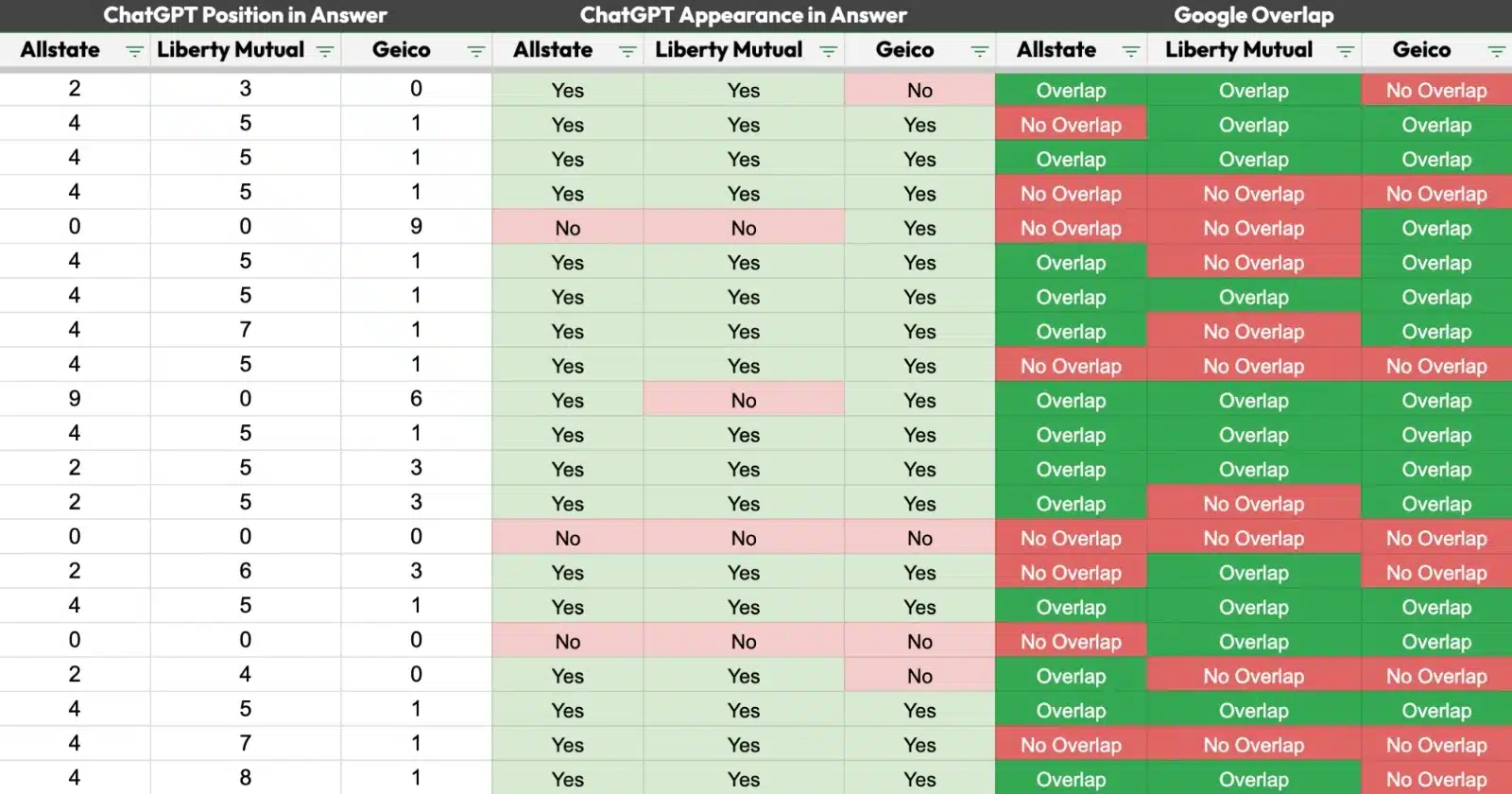
The methodology counts both shared presence and shared absence as agreement. The 62% figure should therefore not be treated as a page-one brand’s probability of appearing in ChatGPT. Nor does it mean that 38% of answers contained completely different brands.
The experiment used API-based, persona-conditioned prompts and standardised ten-brand outputs. It excluded Google Maps results and AI Overviews. Those conditions limit how directly the findings apply to ordinary conversations or to local contractors.
My interpretation is narrow: measure the channels separately. A correlation study does not establish which optimisation tactics caused visibility, and a one-percentage-point browsing difference does not establish how much an answer relied on training versus retrieved sources.
Why a search position and an AI recommendation differ
Think about a homeowner comparing kitchen remodelers in Dallas. A Google query might be “kitchen remodeling Dallas.” A conversational request could add a budget, a preference for design-build service, a neighbourhood, and a need to keep part of the kitchen usable during construction. Those are different selection problems.
OpenAI explains that ChatGPT search can rewrite a request into targeted searches, use location context, and return links to sources. It is not simply a reproduction of Google’s first ten organic results. Search-enabled answers should also be distinguished from responses generated without a live web search.
Keep SEO at the centre of the strategy
GEO, or generative engine optimization, is a useful label for work aimed at visibility in AI-generated answers. It should not become an excuse to neglect technical SEO, useful content, or a business’s local presence.
Google’s guidance on AI features and websites says established SEO practices remain relevant to AI Overviews and AI Mode. It does not require special AI markup or additional technical optimisations. Supporting pages must be indexed and eligible for a search snippet. That guidance is specific to Google’s AI features; it is not a promise about ChatGPT.
For a US service business, I would connect the two efforts through a single content plan, with separate reporting for traditional search and AI answers. The following steps are practical recommendations, not tactics proven by the Chatoptic study.
Make the business easy to identify
Use your real business name, a clear description of your services, accurate contact information, and truthful service-area details. Check that your website and important business profiles describe the same company. Explain distinctions that affect whether you are a good fit: residential versus commercial work, project types, and any minimum project scope.
Consistency means factual agreement. It does not require copying the same paragraph across every directory or repeating a city name throughout an article.
Check access for search crawlers
Ask your developer to review robots.txt, indexing directives, and firewall or CDN rules. A public page can still be blocked from automated access. Keep important explanations available as readable text and connect related articles to relevant service pages.
For ChatGPT specifically, OpenAI’s crawler documentation distinguishes OAI-SearchBot, used for search, from GPTBot, used for potential model training. You can allow search crawling while declining training crawling. Allowing access does not guarantee selection or a recommendation.
Protect local search visibility
Google Maps remains a separate visibility surface to manage. Google’s local ranking guidance describes relevance, distance and prominence, and recommends complete business information. Maintain accurate categories, hours and service details, and respond thoughtfully to real customer reviews.
For contractors, this work belongs alongside local SEO for home service companies. Treat local results, organic listings and AI recommendations as distinct opportunities to reach customers who may be at different stages of choosing a provider.
Publish information that helps someone choose
A blog becomes more useful when it answers the questions that delay a purchase. Start with what customers ask before requesting an estimate, approving a proposal, or comparing two providers.
For example, a remodeling company could explain what changes a kitchen renovation budget, which decisions must be made before work begins, and how the scope affects the schedule. An HVAC company could explain what its replacement estimate includes and which site conditions require an inspection. These are illustrative topics, not findings about any particular client.
Add evidence your business can stand behind
Build articles around real project details, original photos, documented processes, and explanations from the people doing the work. A project story can describe the customer’s goal, site constraints, selected approach, and completed result. Publish customer details only with permission.
When you discuss prices, specify the date, market, scope and exclusions. When a claim depends on permits or local requirements, link to the relevant city or county authority and verify the current rule. Avoid turning one project’s experience into a universal promise.
This approach gives readers a reason to trust the page. It also makes your claims easier to verify. It is not a guarantee that an AI system will cite them.
Use clear answers and useful external links
Put the direct answer near the question, then explain the conditions and exceptions. Use headings that describe the reader’s problem. A comparison table is useful when customers need to evaluate the same attributes across several options; an FAQ is useful when it resolves a genuine follow-up question.
Add an external link where it supports a specific claim: the original research behind a statistic, an official document explaining a platform, or a local authority responsible for a requirement. Tell readers what the source supports. Adding links mechanically does not make an article authoritative.
Earn relevant third-party coverage
Look for credible opportunities to share real expertise through trade organisations, local publications, suppliers and professional partnerships. Prioritise sources that your customers would actually consult. Keep the information accurate and avoid invented awards, purchased praise, or exaggerated credentials.
As part of your monitoring, inspect the sources that repeatedly appear in relevant AI answers. They can reveal missing information or useful places to contribute expertise. Their presence is an observation to investigate, not proof that getting a mention there will produce an AI recommendation.
Test questions that reflect your actual customers
Create a manageable set of prompts around your services and genuine buying situations. Include broad discovery, provider comparisons, service-area questions and specific constraints. Keep neutral discovery prompts separate from prompts that already name your company, so you can distinguish discovery from brand knowledge.
For local testing, specify the target US city or service area. A result generated for one location is not a reliable benchmark for another. Save the exact prompt and answer, and record the date, platform, model when available, search setting and relevant context. Repeat the same set over time to separate recurring patterns from isolated responses.
Measure mentions, citations and business outcomes
A brand name in an answer, a link to your website, and an explicit recommendation are different outcomes. Track each one before combining them into a summary score.
Brand mention rate
Divide the number of valid answers mentioning your brand by the total number of valid answers in the defined test set. For example, 12 mentions across 40 answers equals a 30% mention rate. This is a result for your sample, not your share of all ChatGPT conversations.
Citation and recommendation rates
Record how often an answer cites your domain and how often it explicitly recommends your business. A neutral mention in a comparison should not automatically count as an endorsement. Review whether the description of your services and location is accurate.
Qualified leads and revenue
Track identifiable AI referral visits, inquiries and resulting business where attribution is available. Ask prospects how they discovered you. Some people may see a recommendation and later search your brand or call directly, so referral analytics alone will not capture every influence.
Compare periods using the same prompt set and settings. Report failures separately rather than silently counting them as absent mentions. If you expand the test set, preserve the original group so you can still make a meaningful comparison.
Frequently asked questions
Does ranking first on Google guarantee a ChatGPT recommendation?
No. Treat your Google position and your presence in AI answers as separate observations. Test the relevant questions directly and evaluate whether your business is described accurately.
Should I replace SEO with GEO?
My recommendation is to keep SEO and add focused AI visibility work where it helps your business. Fix access problems, improve the information customers need, and measure changes before committing to a larger program.
Are mentions more important than citations?
They answer different questions. Mentions show that your company appeared in the response. Citations show that a source was linked. Recommendations indicate an explicit suggestion to consider your business. Their commercial value depends on what customers do next.
Can any agency guarantee inclusion in AI answers?
A credible proposal should define the work, reporting and success criteria without promising control over a platform’s selections. Look for transparent evidence of progress and a clear connection to customer acquisition.
In summary
Build a Search Strategy You Can Measure
The next step is to establish where your business appears today, identify the questions that matter commercially, and improve the information available to answer them. Keep the SEO work that supports discovery, and judge new AI visibility efforts by accurate representation and business results.
Explore Infront - AI’s generative engine optimization services to discuss how AI visibility can fit into your broader search strategy.
Yonatan Ben Moshe is the CEO of Infront - AI, an SEO agency based in Cyprus serving businesses in the United States.
Find Out Where You Appear Today
Tell us your trade and your US service area and we will run a live competitive gap analysis alongside the answer, so the first conversation produces something useful either way.