
- Home
- Local SEO for home service companies
Service area businesses
Local SEO for Home Service Companies: Breaking the “Hidden Address” Barrier
Google’s local algorithms were built for shops with a front door. Your crews travel to the customer, and the ranking system quietly holds that against you.
The structural disadvantage
The Storefront Bias: Why Service Area Businesses Struggle on Google
Google’s local search algorithms were originally built for retail stores, coffee shops and restaurants. They inherently favour a physical front door.
That creates a structural disadvantage for service area businesses. A plumber, a roofing crew or a restoration contractor travels to the customer. To comply with Google’s terms of service, these businesses often hide their residential or dispatch addresses online. The unintended consequence is that Google shrinks their visibility radius, burying them beneath competitors who simply happen to be physically closer to the person searching.
Winning high-ticket calls needs an architecture engineered for the SAB model rather than adapted from a retail one. Our specialists execute full-stack local SEO designed to shatter the proximity barrier and establish a contracting business as the dominant regional authority.
The pattern
Better Trucks, Better Reviews, Quiet Phones
You cannot conquer a multi-county service area with a retail-store strategy. The entity has to be re-engineered to push that relevance radius outward.
Yonatan Ben Moshe — Founder & CEO
When we sit down with a home service contractor the frustration is consistent. They have better trucks, better technicians and better reviews than their competitors, and the phones still are not ringing. They assume the SEO is broken. Look at the data and the architecture is fighting Google’s storefront bias.
One page for forty miles
A single “Services” page trying to cover an entire multi-county radius. Google has nothing specific to rank for any one of those areas.
Conflicting directory listings
The same business written several ways across the web, dragging down the trust score exactly where proximity should be strongest.
A hidden address read as a smaller footprint
Suppressing the address is permitted, but without service-area schema and regional depth the algorithm reads the business as smaller than it is.
— Yonatan Ben Moshe, Founder & CEO
Suburb coverage
Conquering the Suburbs: Regional Hubs vs Toxic Spam
The hardest problem for a home service company is ranking in affluent surrounding suburbs where it has no physical address.
For years, agencies solved that by generating hundreds of thin, copy-pasted “contractor in [suburb]” doorway pages. Google’s helpful content systems now actively hunt and penalise that programmatic spam. If your current agency is deploying the tactic, the whole domain carries manual-action risk.
Our technical team expands territory safely instead. We build deep, authoritative regional hubs, weaving precise service-area schema into rich localised content to signal your exact operating footprint without resorting to spam.
We do not ask you to take that on faith. Geographic expansion is proved visually, with before-and-after Google Maps and GEO grid heatmaps showing visibility spreading block by block across target zip codes.
AI search
Intercepting the Zero-Click Homeowner
A homeowner facing an emergency goes to the Map Pack. A homeowner planning a $30,000 kitchen remodel behaves completely differently.
High-ticket buyers increasingly open ChatGPT, Claude and Google AI Overviews and ask compound questions — what the permit process is for a roof replacement in their county, and who the most reliable, highly-rated contractors are.
Physical proximity cannot get you recommended by an AI. Entity consensus can. Our retainers integrate advanced Generative Engine Optimization, deploying LocalBusiness, Service and AggregateRating JSON-LD across the site.
Translating real-world expertise into structured data is what lets a language model cite your business as the definitive local authority, intercepting high-value leads before they ever reach an aggregator.
How the work runs
The Month 1 Rebuild & The Overnight Cycle
Home service contractors work grueling hours. You do not have time to micromanage an agency, but your real-world expertise is the fuel our SEO engine needs.
Our team operates across European and US time zones, so the campaign advances while your crews are in the field and your office is closed. Backend audits run during your day; the high-authority, industry-relevant link acquisition and digital PR that pushes domain authority past entrenched legacy competitors happens overnight.
Alignment with your ownership team is asynchronous by design: a dedicated Slack channel and a 24-hour response commitment, so you review progress on your schedule rather than ours.
The economics
Stop Renting Leads. Build an Owned Asset.
Every dollar spent on a shared pay-per-lead platform vanishes the moment the month ends. Organic search is the only channel that builds compounding equity for a contracting business.
We track success through one metric: verified organic call tracking, which separates SEO calls from paid and direct traffic.
If you are ready to move from a rented pipeline to an owned digital asset, our retainer tiers set out how partnerships are structured.
Our work
Service Area Businesses We Have Done This For
Three campaigns where the problem was holding position across a radius, not at the pin.
-
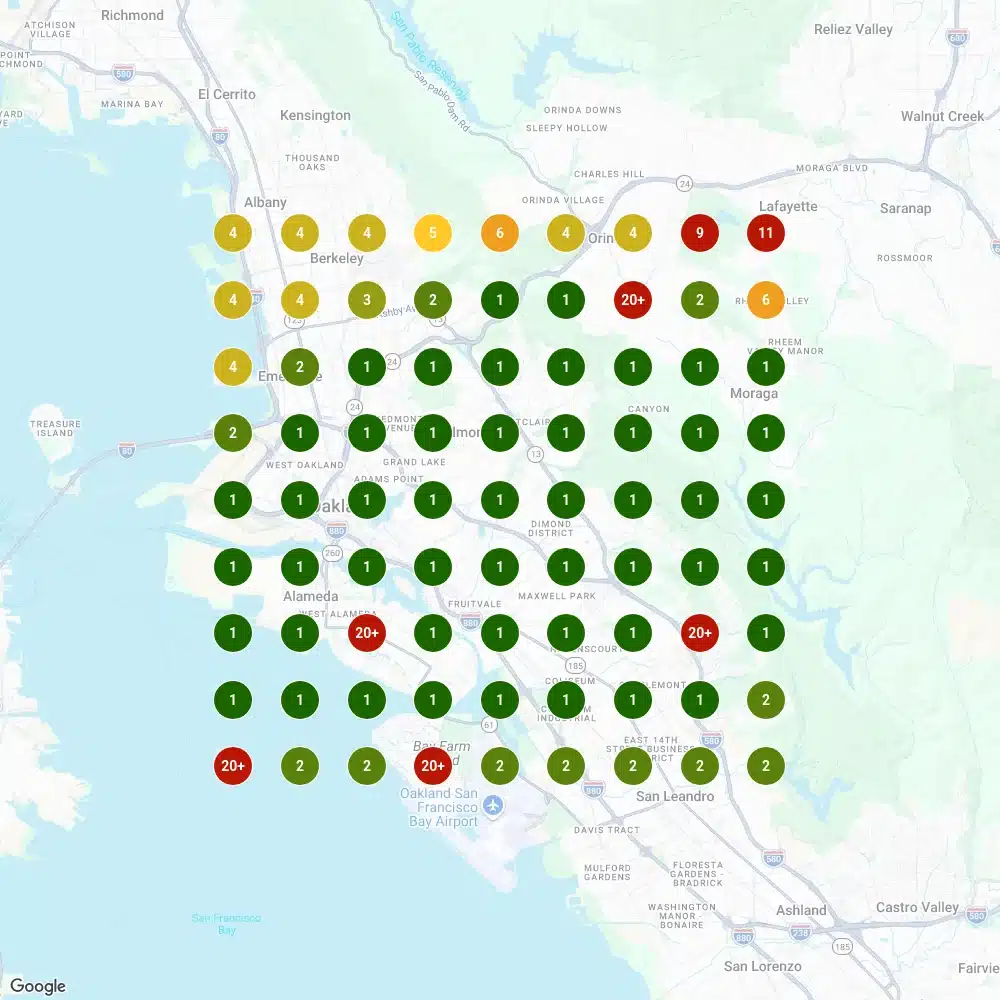 Oakland, CA
Rhino Builders
10.62 → 4.78
Average rank on the head term, across three keywords and six reports.
Read the case study →
Oakland, CA
Rhino Builders
10.62 → 4.78
Average rank on the head term, across three keywords and six reports.
Read the case study →
-
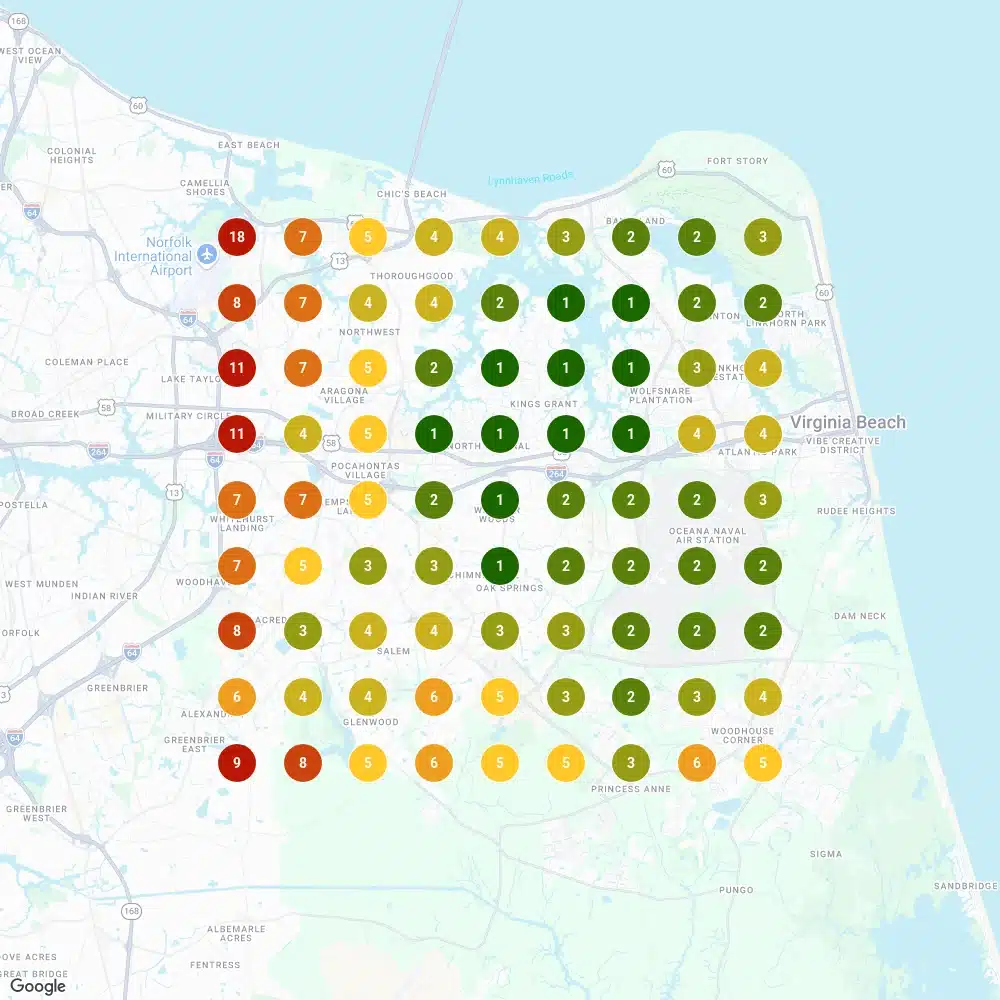 Virginia Beach, VA
Hampton Roads Locksmith
22% → 51%
Top-three grid coverage on “locksmith”, in Google’s most filtered category.
Read the case study →
Virginia Beach, VA
Hampton Roads Locksmith
22% → 51%
Top-three grid coverage on “locksmith”, in Google’s most filtered category.
Read the case study →
-
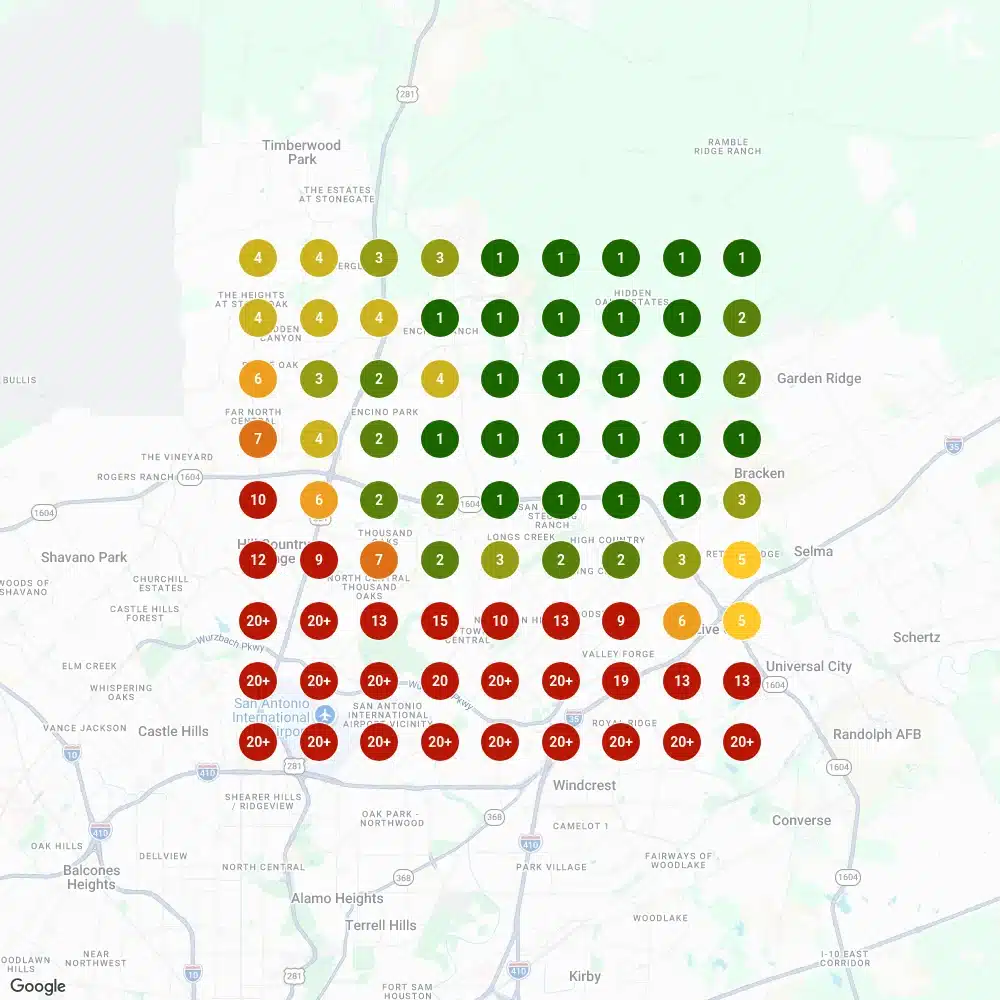 San Antonio, TX
Green Air Duct Club
#8 → #2
Market position among 118 competing air duct companies.
Read the case study →
San Antonio, TX
Green Air Duct Club
#8 → #2
Market position among 118 competing air duct companies.
Read the case study →
Tell Us Your Trade and Your Service Area
We will run a live competitive gap analysis and show you exactly what it takes to own your market — where your radius currently ends, which high-ticket queries you are missing, and what the architecture would need to be.
No commitment. No generic proposal.
Before your first campaign
Questions Contractors Ask
Do I need a new website, and how involved does my team need to be?
In most cases your site will need to be rebuilt — and we do it for you at no extra charge. Dominating organic search and AI engines requires a flawless technical foundation. Instead of putting band-aids on broken architecture, we dedicate the first month of your retainer to rebuilding your site. Once live, your ongoing involvement is critical. To build true E-E-A-T we rely on you to provide weekly raw materials, like job site photos and video testimonials, so we can prove your real-world authority to Google.
Does local SEO work for a business with no physical address?
Yes. Service area businesses rank in the Google Map Pack every day without a customer-facing address. Google explicitly allows SABs to hide their address to protect residential privacy. The signals that actually move the needle for contractors — review velocity, off-page authority and schema markup — do not require a walk-in location.
How long before a home service contractor sees real ranking movement?
Map Pack signals typically begin expanding within 60 to 90 days of targeted profile optimization. Organic keyword rankings for high-ticket service pages generally take four to nine months to establish robustly. We sequence the work so profile and citation corrections generate early momentum while long-term content authority compounds in the background.
Do I need separate pages for every city I serve?
You need a localized strategy, but building individual thin city pages for thirty suburbs is a penalized tactic. We build comprehensive regional hubs that cover your service areas deeply and safely, using service-area JSON-LD schema to signal your footprint to Google and AI engines without spamming the index.